The Engine of the Internet: A Deep Dive into the TCP/IP Model
In my previous article, we broke down the OSI Model, which acts as the theoretical “map” for how networks should communicate. But theory is one thing; reality is another.
Today, we are going to talk about the actual “engine” that powers the internet we use every day: the TCP/IP Model. While OSI is the standard for understanding communication, TCP/IP is the suite of protocols that actually makes it happen.
If the OSI model is the blueprint of a car, TCP/IP is the car itself driving down the highway. Here is how it works, simplified.
The 4 Layers of TCP/IP
Unlike the 7 layers of OSI, the TCP/IP model is more condensed and typically consists of 4 layers.
4. Application Layer
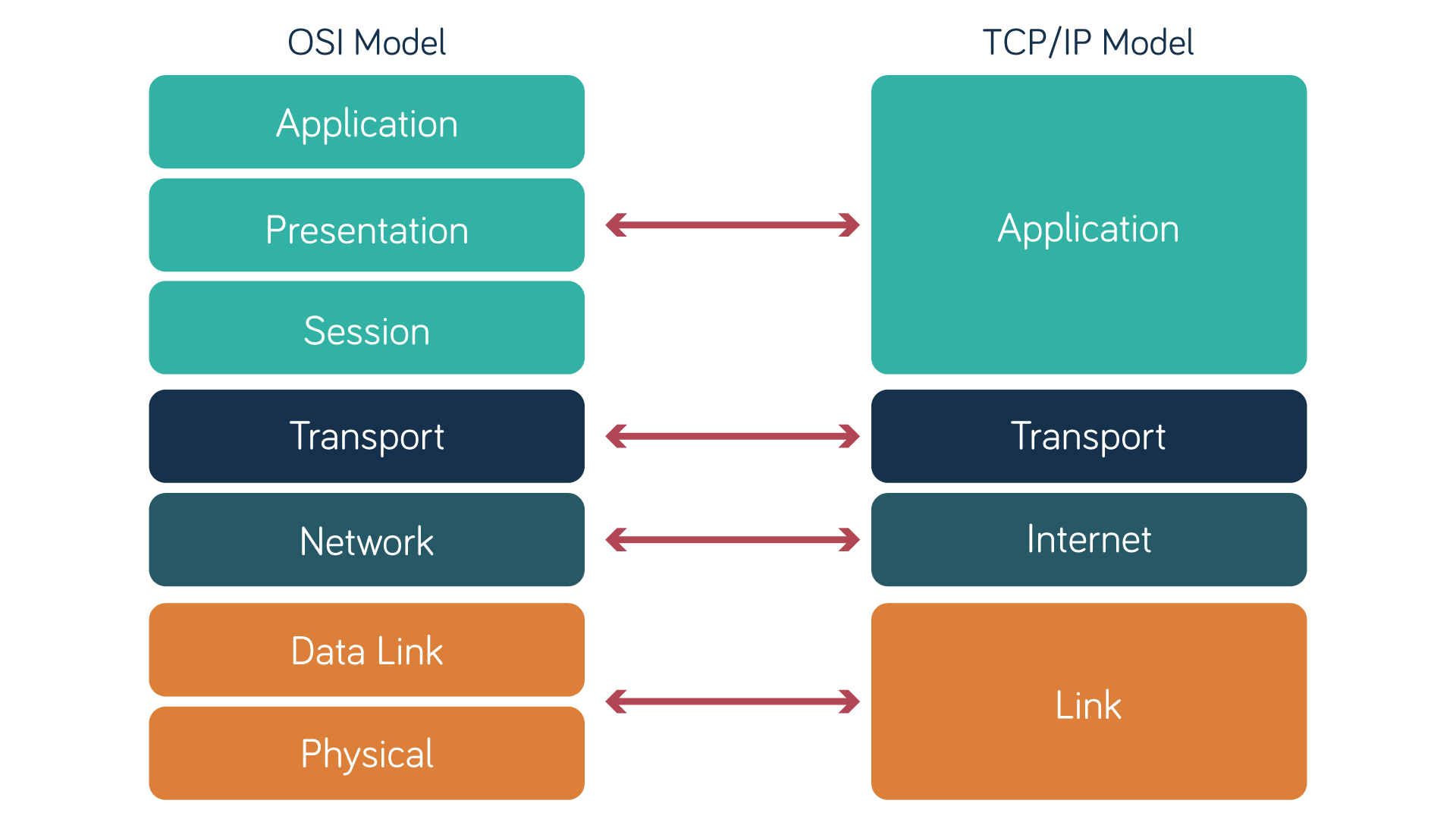
This combines the top three layers of the OSI model (Application, Presentation, and Session).
- Function: It handles the data generation and the interface with the user. It doesn’t worry about how the data gets there, just what the data is.
- Protocols: HTTP (Web), SMTP (Email), FTP (File Transfer).
3. Transport Layer
Just like in the OSI model, this layer ensures the data gets from the source to the destination app.
- Function: It manages the reliability of the connection. It decides if we need a guarantee that data arrived (TCP) or if we just want speed (UDP).
- Analogy: The shipping manager who decides if a package needs a tracking number.
2. Internet Layer
This corresponds to the “Network” layer in OSI.
- Function: It handles logical addressing (IP Addresses) and routing. It finds the best path across the vast network of networks to get the packet to the right destination.
- Protocols: IP, ICMP.
1. Network Access Layer
This combines the Data Link and Physical layers of OSI.
- Function: The physical interface between your device and the transmission medium (wire or Wi-Fi). It handles MAC addresses and the actual electrical signals.
The Analogy: Delivering a Package to Another City
To truly understand how these layers cooperate, let’s step away from computers. Imagine you are in Cairo and you want to send a fragile gift to a friend in Alexandria.
1. Application Layer (The Package & The Order)
This is You. You buy the gift, wrap it up, and write the label with the destination name. You don’t care which highway the driver takes or how the engine works. You just care about the content (the gift) and who it’s for.
2. Transport Layer (The Logistics Company)
You hand the box to a shipping company. They assign a Tracking Number to it.
- They decide the rules: “If the box breaks, we send another one” (This is TCP reliability).
- They verify that the box is going to a specific person (Port number), not just the building.
3. Internet Layer (The GPS and Navigation)
Now the driver gets in the van. He turns on his GPS.
- The GPS sees that the main highway is blocked by traffic, so it calculates a new route through a side road.
- The GPS doesn’t care what is inside the box; it only cares about the Address (IP Address) and the fastest route to get there.
4. Network Access Layer (The Truck and The Road)
This is the physical reality.
- This includes the Delivery Truck itself and the Asphalt Road it drives on.
- If the road changes from asphalt to a dirt road (like switching from Ethernet to Wi-Fi), the truck adapts, but the box inside remains untouched.
TCP/IP vs. OSI Model: What’s the Difference?
It is easy to get them mixed up, so here is the breakdown.
1. Theory vs. Practice
- OSI is a Reference Model. It is excellent for teaching, troubleshooting, and standardization, but it isn’t strictly followed in the real world.
- TCP/IP is an Implementation Model. It is the actual standard the internet was built on.
2. Layer Mapping The TCP/IP model is essentially a condensed version of OSI:
| TCP/IP Layer | Equivalent OSI Layers |
|---|---|
| Application | Application, Presentation, Session |
| Transport | Transport |
| Internet | Network |
| Network Access | Data Link, Physical |
Summary
While the OSI model gives us 7 granular steps to diagnose a problem, TCP/IP gives us the 4 practical steps that data takes to travel the world. As a network engineer or cybersecurity professional, you will use OSI to talk to humans (troubleshooting) and TCP/IP to configure machines.